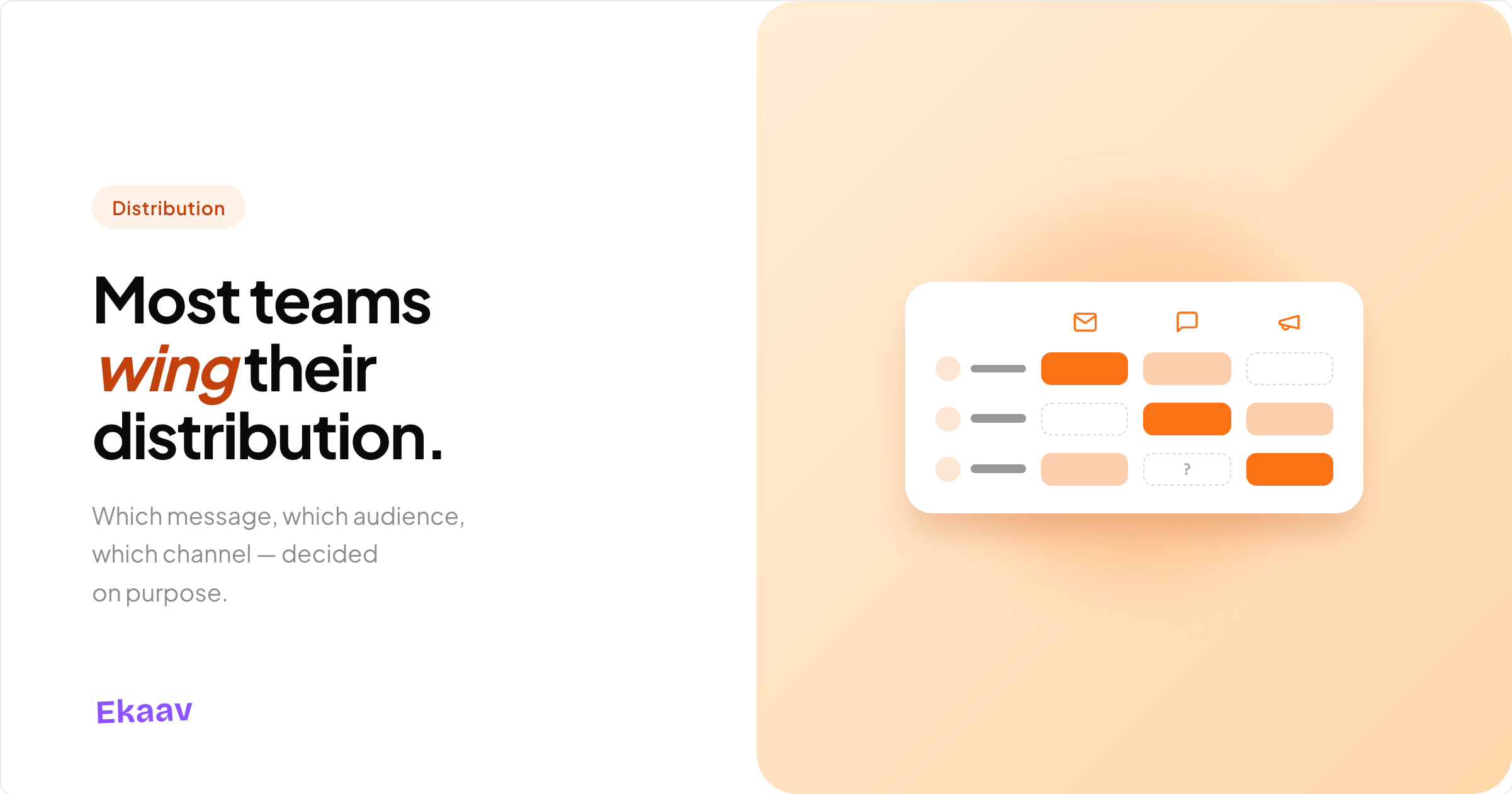
A marketing distribution strategy defines which messaging reaches which audience via which channel.
That is the whole definition. Not a content calendar. Not a channel plan. Not a list of tactics. The specific, deliberate mapping of what you say, to whom, and where — before a campaign begins.
Most teams do not have one. They have channels they use, content they produce, and audiences they vaguely target. But the mapping — the explicit connection between a specific message, a specific audience segment, and a specific channel — happens informally, in someone's head, or not at all.
The result is marketing that feels scattered even when each individual channel is performing. The email says one thing. The LinkedIn post says something adjacent. The paid ad says a third thing. The audience encounters fragments of a strategy rather than a coherent plan.
What a marketing distribution strategy actually is
The term "distribution" in this context has nothing to do with logistics or supply chains. It refers to the distribution of your marketing — how it is spread across your audiences and channels.
A marketing distribution strategy answers three questions simultaneously:
Which messaging? Not your brand positioning in general — the specific message designed for a specific audience at a specific stage. The message for a first-time-aware prospect is different from the message for someone who has already evaluated you and gone quiet. A distribution strategy makes these distinctions explicit.
Which audience? Not your total addressable market — the specific segment this particular message is designed to reach. Founders, marketing managers, agency strategists, and solo marketers all have different relationships to the same problem. A distribution strategy assigns the right message to the right segment rather than broadcasting the same thing everywhere.
Which channel? Not every channel you have access to — the specific channel that reaches this audience in the context where this message lands. LinkedIn reaches B2B decision-makers in a professional browsing mindset. Email reaches people who have already opted in to hear from you. Paid reaches people who were not looking for you. Each channel has a different role, and the distribution strategy assigns each message to the channel where it belongs.
When all three questions have clear answers — and when those answers are mapped together rather than managed separately — you have a marketing distribution strategy.
How it differs from a marketing strategy
A marketing strategy defines what you are trying to achieve and who you are trying to reach. It sets the goal, the audience, the positioning, and the broad approach.
A marketing distribution strategy is the layer below that. It takes the strategy and specifies how it reaches people. Which messages. Which segments. Which channels. In what sequence. At what stage of the buyer journey.
The strategy says: we are targeting mid-market SaaS companies with a message about operational efficiency.
The distribution strategy says: the awareness message goes to marketing managers via LinkedIn organic and paid, the consideration message goes to CMOs via email nurture and case studies, and the conversion message goes to active evaluators via retargeting and sales outreach.
One defines the intent. The other defines the execution of the reach. Both are necessary. Most teams have the first and skip the second.
Why most teams wing it
The distribution layer gets skipped for three consistent reasons.
It feels like it should happen automatically. Once the strategy is clear and the content is created, the assumption is that distribution figures itself out — post the content on the relevant channels, run the ads to the right audience, send the emails to the list. The mapping is implicit rather than explicit. Which means it is different every time, inconsistent across channels, and invisible to anyone who was not in the room when the decisions were made.
The tools do not support it. A content calendar shows when things go out. A project management tool shows who is doing what. An analytics platform shows what happened after. None of them show the mapping — which message is reaching which audience via which channel, and whether that mapping is coherent and complete. Without a tool that makes the distribution layer visible, it stays invisible.
It gets built after the campaign instead of before it. Most teams do a version of distribution strategy retrospectively — they look at what worked, which channels drove results, which messages resonated with which audiences. That learning is valuable. But it does not help the campaign that is launching next week. Distribution strategy built before the campaign changes what you create, which channels you prioritise, and how you sequence your messaging. Built after, it is just analysis.
What a marketing distribution strategy makes visible
When the distribution layer is mapped explicitly — before the campaign begins — three things become immediately visible that are invisible without it.
Coverage gaps. Which audience segments have no message reaching them? Which channels are being used for everything while others sit idle? Which stage of the buyer journey has no touchpoints planned? A distribution map shows the full picture, which means the gaps are obvious before execution rather than after.
Message consistency. Are two campaigns reaching the same audience segment with contradictory messages simultaneously? Is the awareness message on LinkedIn consistent with the consideration message in email? Without a distribution map, these inconsistencies are discovered by the audience before the marketing team notices them.
Strategic coherence. Does each message belong on the channel it is assigned to? Is the sequence of touchpoints designed to move the audience from one stage to the next, or is it a collection of individual pieces with no connective logic? The distribution map makes the logic visible — or reveals that the logic does not exist yet.
What it looks like in practice
A marketing distribution strategy is not a 40-page document. At its most useful it is a visual map — a single view showing which messages connect to which audience segments via which channels, across the timeline of a campaign.
For a product launch it might show:
- Awareness message → cold audience in the target vertical → LinkedIn paid and organic
- Consideration message → warm prospects who have visited the pricing page → email sequence and retargeting
- Conversion message → active evaluators in the pipeline → sales outreach and case studies
- Retention message → new customers in the first 30 days → onboarding email and in-app
Each row is a distribution route. Together they show the full strategy — who hears what, where, and when.
That view does two things simultaneously. It makes the strategy executable — everyone who needs to create content, run ads, or send emails can see exactly what they are doing and why. And it makes the strategy communicable — a founder, a client, or a stakeholder can see the full plan without needing a briefing.
Why the visualisation matters as much as the plan
A marketing distribution strategy that exists in a spreadsheet or a document is better than one that does not exist at all. But it has a consistent limitation: the people who need to understand it have to read it before they can see it.
A visualised distribution strategy — one where the mapping of messages, audiences, and channels is laid out spatially rather than described linearly — communicates the strategy at a glance. The coverage gaps are visible without analysis. The channel mix is obvious without counting rows. The sequence of touchpoints is legible without following a numbered list.
More importantly, a visual distribution strategy can be shared as something interactive — something the viewer explores rather than reads. A client can click through the distribution routes and understand how their campaign reaches their audiences. A founder can see what marketing is doing without a status meeting. A new team member can understand the campaign strategy on day one without a two-hour briefing.
This is the difference between presenting a marketing distribution strategy and sharing one.
Building yours
The fastest way to build a marketing distribution strategy is to start with your audiences and work outward.
List the specific segments you are trying to reach in this campaign. Not your full addressable market — the two or three segments this campaign is specifically designed for.
For each segment, identify where they are in the buyer journey. Are they encountering your brand for the first time? Are they actively evaluating? Are they already customers you are trying to retain or expand?
For each segment at each stage, define the specific message they need to hear. Not your general positioning — the specific thing that moves this segment from where they are to the next stage.
Then assign each message to the channel that reaches this audience in the right context for this stage. Awareness messages belong on channels where discovery happens. Consideration messages belong on channels where evaluation happens. Conversion messages belong on channels where decisions happen.
Map it visually. Look at what you have. The gaps will be obvious. The inconsistencies will be visible. The questions you need to answer before execution begins will surface naturally.
That is your marketing distribution strategy. Built before the campaign, not after it.
Ekaav is a marketing distribution strategy tool. Visualise exactly which messaging reaches which audience on which channels — then share it as an interactive playbook anyone can explore.