Everyone says they have a marketing playbook.
Ask a marketing director how their team runs campaigns and they will tell you there is a playbook. Ask a freelance marketer how they onboard new clients and they will mention the playbook. Ask an agency how they train new hires and the playbook will come up.
Almost nobody actually has one.
What they have is documentation. A Google Doc. A Notion page. A folder of past campaigns with a README. A slide deck from the last time someone presented the strategy to leadership. Good material. Useful as reference. Not a playbook.
The distinction matters — and it matters more than most teams realise — because a document and a playbook do fundamentally different things. Confusing the two is why most marketing teams keep having the same problems regardless of how much they invest in documentation.
What a playbook actually is
A playbook, in the original sense, is a book of plays. In American football, a play is not a description of good football. It is a specific, executable sequence of actions that the team runs from a defined starting position. Every player knows their role. Every decision is pre-made. The play runs the same way every time it is called.
A marketing playbook is the same idea applied to marketing work. It is a collection of defined, executable processes — the specific sequences of steps, decisions, and handoffs that produce a consistent outcome for a given type of campaign or situation.
The operative word is executable. A playbook is not something you read. It is something you run.
Three things make a playbook different from a document:
It is built around execution, not explanation. A document explains how something works. A playbook defines how something runs. The difference is the difference between a map and a set of turn-by-turn directions. Both describe the same territory. Only one is useful when you are driving.
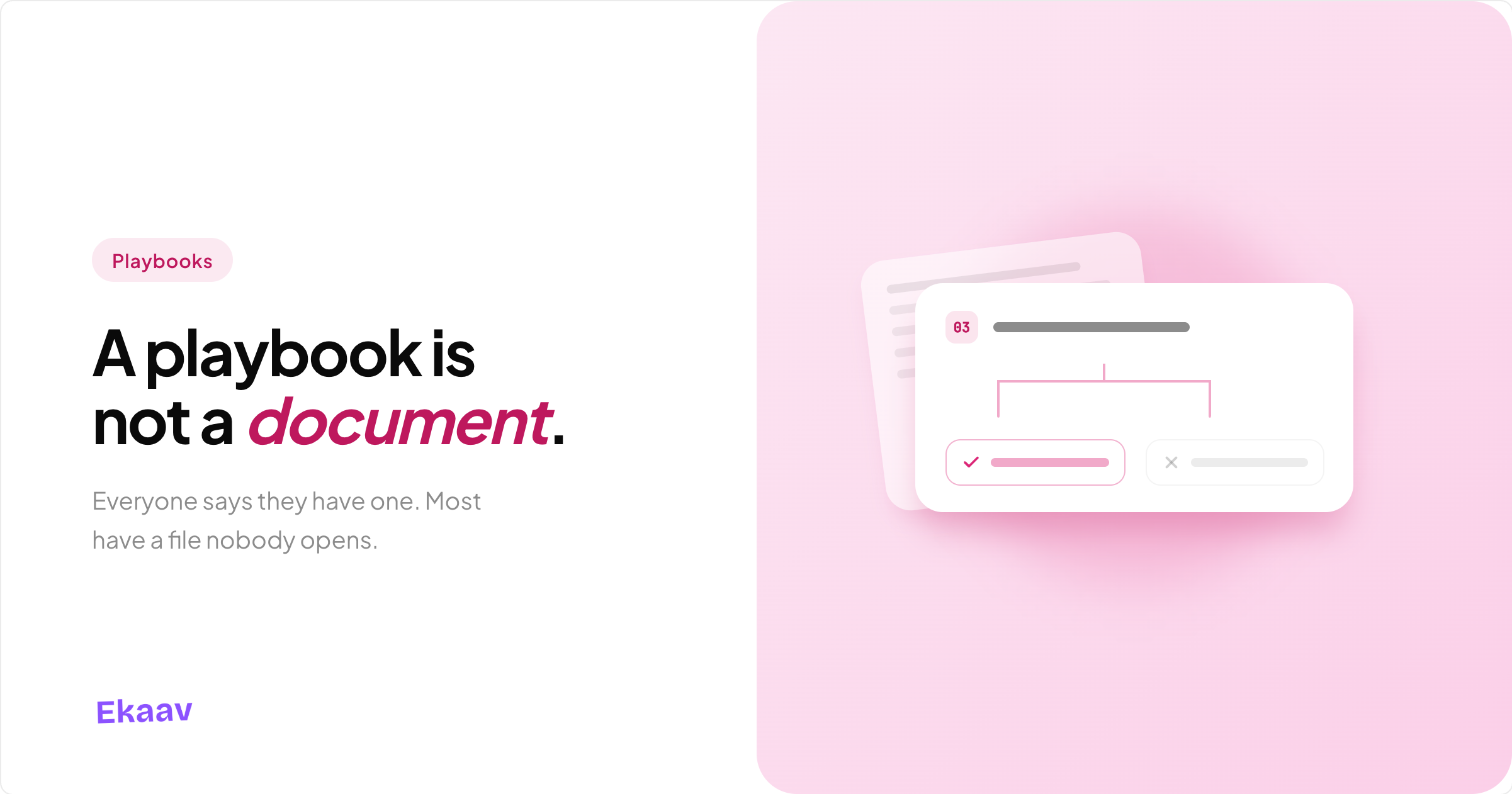
It handles branches. Real marketing work is not linear. A campaign brief process looks different when the client has existing brand assets than when they do not. A launch sequence looks different when the initial paid test works than when it fails. A playbook documents these branches explicitly — at each decision point, it tells you what to do depending on what just happened. A document describes the path that assumes everything goes according to plan.
It transfers. A playbook can be handed to someone who has never run this type of campaign before and they can execute it correctly without a briefing from the person who wrote it. If the documentation requires a verbal explanation to make sense, it is not a playbook. It is notes.
Why the difference matters
Consider two scenarios that play out in marketing teams constantly.
Scenario one. Your best account manager goes on parental leave. A junior takes over their client. The junior has access to all the documentation — the campaign briefs, the strategy slides, the past campaign reports. Three weeks in, the client is unhappy. Not because the junior is incompetent. Because the documentation describes what good campaigns look like but does not define how to run them. Every decision requires judgment the junior does not yet have. Every decision gets escalated or guessed.
Scenario two. You brief an agency on a campaign type you have run dozens of times internally. The brief is comprehensive. The agency comes back with work that misses the mark in ways that are hard to articulate. Not wrong, exactly. Just not quite right. The specific sequencing you always use. The checkpoint you always build in before the client sees anything. The particular way you handle the handoff between strategy and creative. None of that was in the brief because none of it was documented anywhere. It lived in the head of whoever ran the last ten campaigns.
In both scenarios, the team had documentation. In neither scenario did they have a playbook. The gap is not the amount of documentation. It is whether the documentation can run the process without the person who built it.
What most "playbooks" are missing
Most marketing playbooks are missing the same three things.
The decisions. A document that lists steps without specifying what to do at decision points is not a playbook — it is an outline. The decisions are where the process lives. They are also where the most valuable institutional knowledge is stored. When should you push back on a client's brief? When should you escalate a timeline concern rather than absorb it? When should you run a small paid test before committing the full budget? These decisions happen constantly in experienced marketers' heads. They almost never appear in documentation.
The conditions. A playbook needs to specify not just what to do but when. Not "write the campaign brief" but "write the campaign brief after the audience has been confirmed and the goal has been set — if either is unclear, resolve it before touching the brief." Conditions make a process executable in the real world rather than the ideal one.
The failure paths. Most documentation describes the happy path — the sequence of events where everything goes according to plan. Real campaigns do not always go according to plan. A playbook documents the most common failure modes and specifies exactly what to do when they occur. What happens when the client misses a deadline? What happens when the paid campaign produces no signal in the first week? What happens when the creative comes back and it is wrong? A playbook has answers. Documentation pretends the question will not arise.
The playbook as a product of experience
Here is the uncomfortable truth about most marketing playbooks: the reason they do not exist is not that nobody thought to build them. It is that building a real playbook is genuinely hard.
It requires the most experienced person on the team to externalise knowledge they have been accumulating for years. Knowledge that has become automatic — that they exercise without thinking — is the hardest kind to document. You cannot describe what you no longer notice yourself doing.
Building a real playbook requires watching yourself work. Naming every decision. Articulating every branch. Writing down not just what you do but what you do when things go wrong.
This is slow, uncomfortable work with no immediate payoff. The campaign you are currently running takes priority. The playbook gets deferred until the next quiet moment, which arrives less often than expected.
The result is that most marketing teams operate on invisible playbooks — processes that exist in experienced people's heads, that produce good results when those people are in the room, and that break down the moment they are not.
What a playbook makes possible
When a real marketing playbook exists — documented as a sequence with explicit decisions, conditions, and failure paths — it changes the economics of marketing work in specific ways.
Onboarding time drops. A new hire or freelancer can execute correctly from week one because the process is defined well enough to follow without a verbal briefing. The experienced person's time is freed for the work that requires judgment rather than the work that requires presence.
Agency output improves. A brief derived from a documented playbook contains not just what you want but how you want it produced — the specific decisions and checkpoints the agency needs to make in order to deliver something that feels like it came from your team rather than theirs.
Consistency scales. When you are running one campaign, the process lives in your head and the output is consistent. When you are running ten simultaneously, it cannot all live in your head, and the output varies. A documented playbook is the thing that makes consistency possible at scale.
Institutional knowledge survives people. Good people leave. They take their processes with them. A playbook is the mechanism for ensuring that what they built continues to produce results after they are gone.
Building yours
The fastest path to a real marketing playbook is not to start from scratch. It is to document what already exists informally.
Pick the type of marketing work your team or practice does most frequently and most consistently. Identify the person who runs it best. Map the process as they actually run it — not the idealised version, but the real one, including the branches and the failure paths.
Then document it in a format that handles branches — one where each decision point is explicitly marked and the guidance for each path is immediately accessible. Not a linear document that describes the ideal campaign. A structured process that runs the real one.
That is a playbook. It is more useful than any document you have written so far, and it is harder to build — which is exactly why it is worth building.
Ekaav is a marketing playbook builder for individuals and teams. Build processes with steps, decisions, and branches — then share them with your team or clients so the work runs the same way every time.